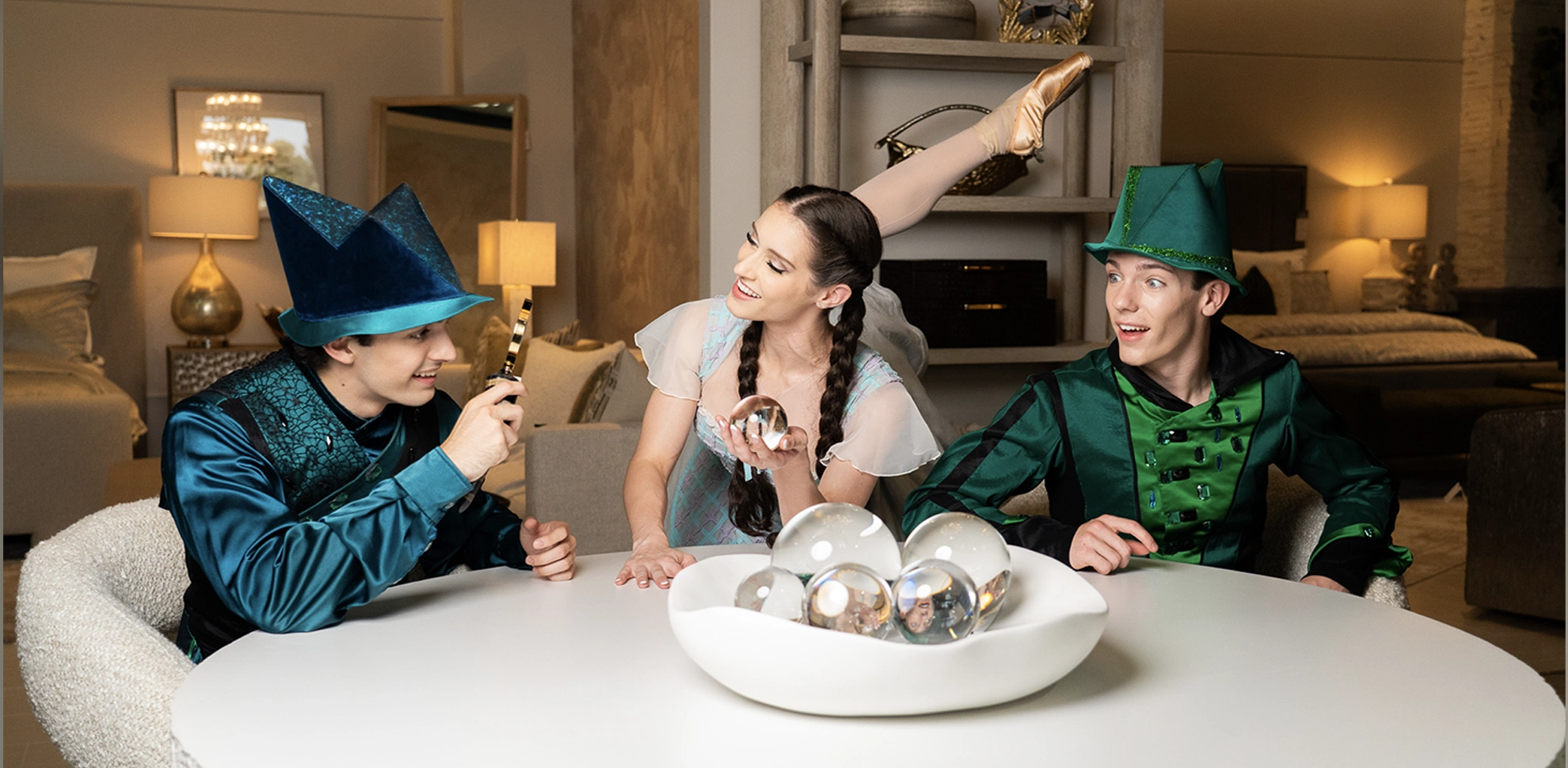
There’s a reason a well-made costume and a well-designed room can both stop you in your tracks: someone thought carefully about every detail, from the fabric to the finish, long before you ever saw it. Recently, that shared sensibility took center stage as Kansas City Ballet Costume Director Jennifer Carroll and the team at Seville Home, presenting sponsor of The Wizard of Oz, came together for a photoshoot at Seville Home’s Leawood showroom. Costumes from across KC Ballet’s repertoire, including Dorothy’s iconic look and several of the Emerald City’s male costumes, were styled alongside pieces from Seville Home’s floor. The pairing revealed just how much the two crafts have in common: a devotion to craftsmanship, an eye for color and texture, and the power to turn a story into something audiences carry with them.
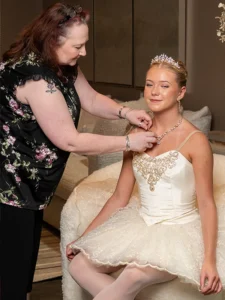
A trained eye for the unseen
Ask a designer what they notice first, and it’s rarely what everyone else sees. For Seville Home Senior Interior Designer Becky Mosby, it’s the fit: the way a costume sits on a dancer, the texture, the color, any sequin or contrast stitching that makes a piece pop. “Details really do make the difference,” she said. On the furniture side, that same instinct shows up as tailoring: straight stitching, well-fitted cushions, drawers that close the way they should.
Jennifer Carroll notices something similar when she walks into a showroom. At Seville Home, she found herself drawn to how each vignette, a rug, a couch, a throw, was grouped so the whole setting felt like it belonged to one world. It’s the same principle she applies to costuming The Wizard of Oz: Kansas costumes stay muted and plain, evoking the plains, while the Oz costumes turn vivid and saturated, so the audience feels the shift between the two worlds the moment the curtain rises.
Designing for a person, dressing for a character
Both crafts, it turns out, are really about telling someone’s story. Becky described a recent Seville Home project for a couple who lived in jeans and T-shirts but had inherited a bedroom dripping in gold silk and a four-poster canopy bed. “I said, who did this to you? This is not you,” she recalled. The fix was tailoring the room back down to who they actually were: softer textures, simpler furniture, a look that finally matched the people living in it.
Jennifer does the same work in reverse, starting with a character instead of a client. The clearest example in The Wizard of Oz is the transformation of the three farmhands into the Tin Man, the Scarecrow and the Lion. Designer Liz Vandal built subtle echoes into their human costumes well before the transformation: a formal hat for the farmhand who becomes the Tin Man, straw tucked into a pocket for the future Scarecrow, an aviator cap that foreshadows the Lion’s mane. The same quiet mirroring carries through Miss Gulch’s transition into the Wicked Witch. “A lot of it is done very subtly, through colors, textures, accessories,” Jennifer said.
What came to the shoot
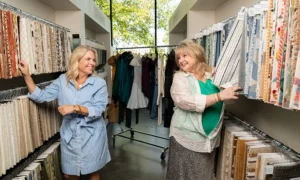
Every piece the designers brought had a reason behind it. Seville Home’s Becky chose a green velvet, drawn to how it evokes the Emerald City. Jessica Gordon, another senior interior designer with Seville Home, brought a blush fabric threaded with metallic gold, a nod to something softer and more feminine, with a bit of sparkle built in.
Jennifer brought Dorothy’s costume and several of the male Emerald City looks, pieces built to read clearly from the back row while still holding up to a close, in-person look. Next to Seville Home’s furniture, the comparison was hard to miss: both crafts layer texture, color and shape until something specific and deliberate emerges.
The craft behind the craft
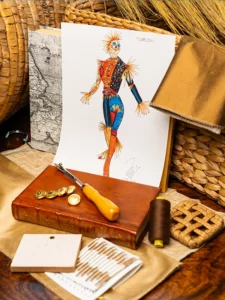
Ask Jennifer which costume in KC Ballet’s history means the most to her, and she doesn’t hesitate: the Sugar Plum Fairy tutu from Devon Carney’s The Nutcracker. Its pressed-velvet leaves aren’t purchased; they’re made the old-fashioned way, pressed into shape using an antique iron dye cast and heat, a technique that requires a specific and increasingly rare kind of craftsperson. “The first time I saw it, I actually teared up,” she said.
That kind of specialist is harder to find every year, especially since the pandemic accelerated a wave of retirements among skilled costumers. Jennifer has noticed some younger stitchers coming up who share the same pride in their work but not always the same attention to the smallest details, the ones an audience member may never consciously register but that make a costume read well from far away, and make a dancer feel like the character.
One craft, two showrooms
By the end of the shoot, both teams landed on the same word: mood. A room, like a costume, isn’t just something to look at. It’s something meant to be felt, whether that means walking into a home designed around how its owners actually want to live or watching a character cross the stage and understanding exactly who they are before they say a word.
As Seville Home puts it: “Exceptional design and exceptional performances share something in common: they have the power to inspire, tell a story, and create lasting memories.” After all, there’s no place like Seville Home, and no place like the ballet, to spark imagination in audiences of all ages.
Watch this video to go behind the scenes of the Seville Home photoshoot!
—
Seville Home is the presenting sponsor of Kansas City Ballet’s production of The Wizard of Oz, running Oct. 16-25 at the Muriel Kauffman Theatre in the Kauffman Center for the Performing Arts. To learn more about becoming a Kansas City Ballet sponsor, please contact Corporate and Foundation Relations Manager Lacy Gordon at 816.451.8757 or lgordon@kcballet.org.
Header image: Kansas City Ballet KCB II dancers bring The Wizard of Oz to life in Seville Home’s Leawood showroom. Photo by Beeh Moynagh.