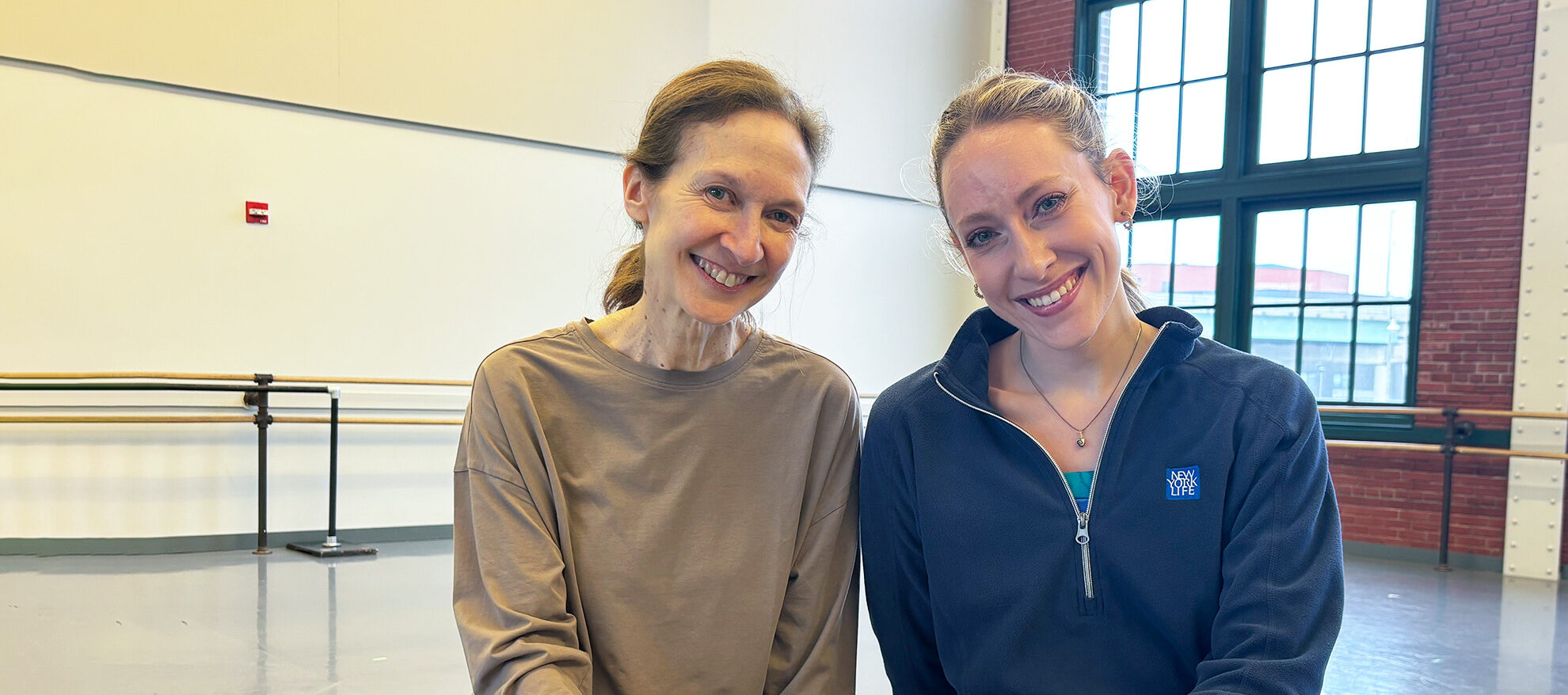
Picture a classically trained ballerina – someone who has performed on stages from St. Petersburg, Russia, to Lincoln Center in New York – standing in a rehearsal studio, consciously trying to forget everything she knows about how to move. No elegant port de bras. No lifted chin. Just a scrappy, boots-on-the-ground cowgirl who doesn’t quite fit in and very much doesn’t care who knows it.
For Kansas City Ballet dancer Marisa Whiteman, that’s both the challenge and the joy of Rodeo.
“I’m trying to approach this less as a dancer and more as a human,” Marisa says with a laugh. “It’s a lot to take in.”
As Kansas City Ballet prepares to bring Agnes de Mille’s beloved American classic to the Kauffman Center for the Performing Arts March 20-29, part of Stars and Stripes, the company’s tribute to America’s 250th birthday, here’s a look inside the rehearsal room where history, heart, and a pair of cowboy boots are coming together in something extraordinary.

A Direct Line to a Legend
Diana Gonzalez-Duclert doesn’t just know Rodeo. She learned it from the woman who created it.
As Agnes de Mille’s last rehearsal assistant from 1987 to 1993, Diana worked side by side with one of American dance’s most visionary choreographers until nearly the end of de Mille’s life. Today, as Associate Director and repetiteur for The De Mille Working Group, Diana has brought Rodeo to companies including American Ballet Theatre and the Martha Graham Dance Company, among others. Now she’s in Kansas City, and she’s brought de Mille’s spirit with her.
What made de Mille unforgettable, Diana says, wasn’t just her choreography. It was her mind.
“I can’t remember a step I choreographed yesterday,” de Mille once told Diana, “but I can remember how someone buttons their coat 30 years ago. I have a writer’s mind.”
That observational instinct shaped everything about how she worked.
“With de Mille, it never starts with the steps,” Diana explains. “It always starts with the story and the drama.”
And the story at the heart of Rodeo was, in many ways, de Mille’s own.
The Strong Woman, Then and Now

Set on a ranch in the American Southwest, Rodeo tells the story of a tomboy Cowgirl who doesn’t quite fit in – too rough, too spirited, too stubbornly herself. She competes against polished local girls for the attention of the Champion Roper, gets knocked down more than once, and ultimately discovers that the man worth loving is the one who sees her exactly as she is.
De Mille premiered Rodeo in 1942. The country was at war. And here was a choreographer telling audiences: be who you are, and love will meet you there.
“She believed in the strong woman at a time when not everybody did,” Diana says. “She was a trailblazer.”
De Mille captured that vision in 1931, writing in Theatre Arts Monthly that the new woman dancer “is interested in the relation of her spirit to humanity and the social forces that have gripped her life.”
More than 80 years later, that message still lands. “We’re finding that bringing this ballet to the generation right now, they are giving it a whole new energy,” Diana says. “It feels like Rodeo is getting a whole new life.”
Boots, Heartbreak, and Getting Back Up

Marisa Whiteman has played princesses and pixies, but nothing quite like this.
The Cowgirl’s emotional arc is relentless: yearning, rejection, shame, defiance, and ultimately joy. “Every emotion has its different weight when you’re dancing it,” Marisa says. “You have to let your whole body feel it, not just look like it.”
Heavy costumes and boots where pointe shoes usually go don’t make it easier. But Marisa sees them as allies. “The costumes are going to help us feel more grounded,” she says. The boots alone, she notes, are a world unto themselves.
What Marisa brings to the role, Diana says, is something that can’t be taught: determination. “Eventually you have to get yourself back up and try again. Marisa does that really well, and it suits this role perfectly.”
Marisa knows something about that. Three hip surgeries. Two and a half years away from the stage. Learning to walk again – more than once. “I’m getting knocked down, but I’m going to get back up,” she says. “The Cowgirl does that. Agnes did that. It’s just a human thing.”
Come Be Part of It
Rodeo joins George Balanchine’s Stars and Stripes and the world premiere of A Home Away by choreographer Caili Quan for Kansas City Ballet’s celebration of America’s 250th anniversary, March 20-29 at the Kauffman Center.
The boots will hit the floor. The Cowgirl will fall, and rise, and fall again. We’ll see you there.
To support Kansas City Ballet in bringing more great works like Rodeo to Kansas City, contact Kristin Castle, Chief Philanthropy Officer, at 816.216.5585 or kcastle@kcballet.org.