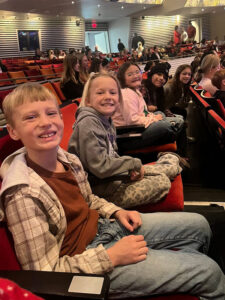
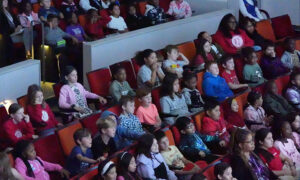
Every year, long before the sun comes up over Bethany, Mo., a school bus pulls out of the South Harrison Elementary parking lot carrying 60 to 70 students and teachers toward Kansas City. The ride takes an hour and a half each way, three hours total, just to spend an afternoon at the Kauffman Center for the Performing Arts. For music teacher Julie Kunce, that drive is never a question. It’s a tradition worth protecting.
Kansas City Ballet’s Matinees for Schools program brings thousands of students from across the region to experience live, professional dance each season, many for the very first time. But few schools travel as far, or with as much intention, as South Harrison. Kunce coordinates the trip for the district’s fourth graders, and for good reason: fourth grade is the final year of elementary school in South Harrison, making the matinee a send-off tradition before students move on to middle school the following year.
A Door to a New World
“For our students, this trip opens the door to a world they otherwise may never experience,” Kunce said. “We are a small, rural district in northwest Missouri, about an hour and a half from Kansas City. For many of our students, attending The Nutcracker at the Kauffman Center is truly a once-in-a-lifetime opportunity.”
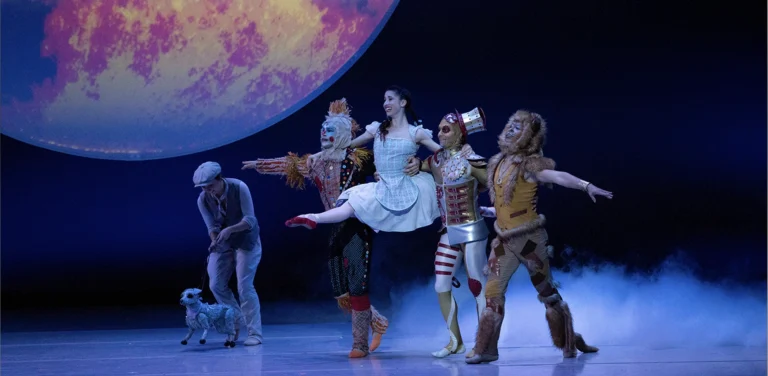
In the weeks leading up to the performance, Kunce’s classroom becomes an introduction to everything ballet has to offer. Students learn about Tchaikovsky and the history of The Nutcracker, explore how stories can be told through music and movement, and discuss the many careers, from lighting to costume design to stage effects, that come together to create a single production. She even covers audience etiquette, so students feel confident and comfortable once they take their seats.
“By the time we arrive, they understand they aren’t simply watching a performance,” she said. “They’re experiencing something special.”
Skeptics Turned Believers
That preparation pays off in ways Kunce has come to expect and still finds moving every time. Some of her students, particularly a few of the boys, walk in skeptical. That changes quickly once she shares that many professional athletes, including NFL players, have trained in ballet. Watching clips of the Russian Dance and the Sugar Plum Fairy variation beforehand gives students a new appreciation for the strength and precision they’re about to witness.
Then there’s the moment the bus pulls up to the Kauffman Center itself. “Some have even said, ‘We get to go in there?’” Kunce recalled. “Walking into the theater, they’re completely awestruck.”
Moments That Stay With Them
She’s watched students grow emotional as the orchestra begins to play, and by the final curtain, some are moved to tears simply by the beauty of it all. One student attended only because his mother insisted. The next day, Kunce got a call: he hadn’t stopped talking about the performance since he got home. “Mom, you have to go see it,” he told her. “I’ve never seen anything like that before. Could we go as a family next year?” Another student had spent weeks predicting the trip would be silly. By the finale, Kunce looked over and saw tears on his face. When she quietly asked if he was okay, he told her, “This is the most amazing thing I think I’ve ever seen. It’s way better than anything I’ve watched online.”
Some students leave with more than a memory. Kunce said several have told her afterward that they want to work in lighting, stage effects, costume design or music because of what they experienced that day.
A “Because” Moment
For Kunce, moments like these are proof of something she believes deeply: access to the arts shouldn’t depend on geography. “Students in rural communities deserve opportunities to experience excellence in the arts just as much as students who live in larger cities,” she said. “Without programs like this, many of our children simply would not have this opportunity.”
She often thinks of “Because,” a children’s book by Mo Willems about a girl whose life is changed by a chain of small, ordinary events that lead her to hear an orchestra perform. “I often think that your Matinees for Schools program is that ‘because’ moment for many of our students,” Kunce said. “It certainly was for me as a child. Please don’t underestimate the impact of what you are providing. You never know whose life you may be changing simply by giving them the opportunity to experience great art.”
Looking Ahead
This season, Matinees for Schools is supported in part by funding from Jackson County, Mo. As Kansas City Ballet looks ahead to sustaining and growing this program for schools across the region, stories like Kunce’s, from South Harrison, are a reminder of what’s at stake, and what’s possible, when students get the chance to see live performance for themselves.
“The joy on their faces, the conversations on the ride home, and the lasting impact the experience has on them remind me every year why we keep coming back,” Kunce said. “Thank you for investing in schools like ours and for making these opportunities possible.”
Interested in supporting Matinees for Schools?
To learn more about supporting Matinees for Schools and helping bring experiences like this to students across the region, contact Kristin Castle, Chief Philanthropy Officer, Kansas City Ballet, at kcastle@kcballet.org or 816. 216.5585.
Header image: South Harrison Elementary School students in the lobby of the Kauffman Center for the Performing Arts. Photo courtesy of Julie Kunce.